Cultural Context
The orisha are not relics of a vanished belief system — they are active presences in the daily and ceremonial lives of tens of millions of people today. In Yoruba tradition, the orisha are divine forces who once walked among people and now govern the natural and moral order: Shango commands thunder and justice, Oshun flows through rivers as beauty and fertility, Ogun forges iron and protects craftsmen and soldiers, and Yemoja, mother of the orisha, holds the ocean and motherhood itself.
Each orisha has a personality, a temperament, sacred colors, numbers, and offerings. They are approached less like distant gods and more like powerful elders in an extended spiritual family — capable of anger, generosity, vanity, and love. This relational, embodied theology is central to understanding why the orisha proved so adaptable: they were never abstract doctrine. They were personal relationships, and relationships travel.
Historical Background
Before European contact, Yoruba city-states such as Oyo and Ife flourished in what is now southwestern Nigeria and Benin, with orisha veneration woven into governance, craft guilds, and family lineage. This was a sophisticated religious system with priesthoods, initiation structures, and oral scriptures — the Ifa divination corpus — passed down through trained specialists.
Between the 15th and 19th centuries, the transatlantic slave trade forcibly removed millions of West Africans, including large numbers of Yoruba people, to the Americas. Enslavers stripped away language, kinship, and often names — and demanded conversion to Catholicism, sometimes under threat of death. Yoruba people faced what looked like an impossible choice: abandon their gods, or lose their lives.
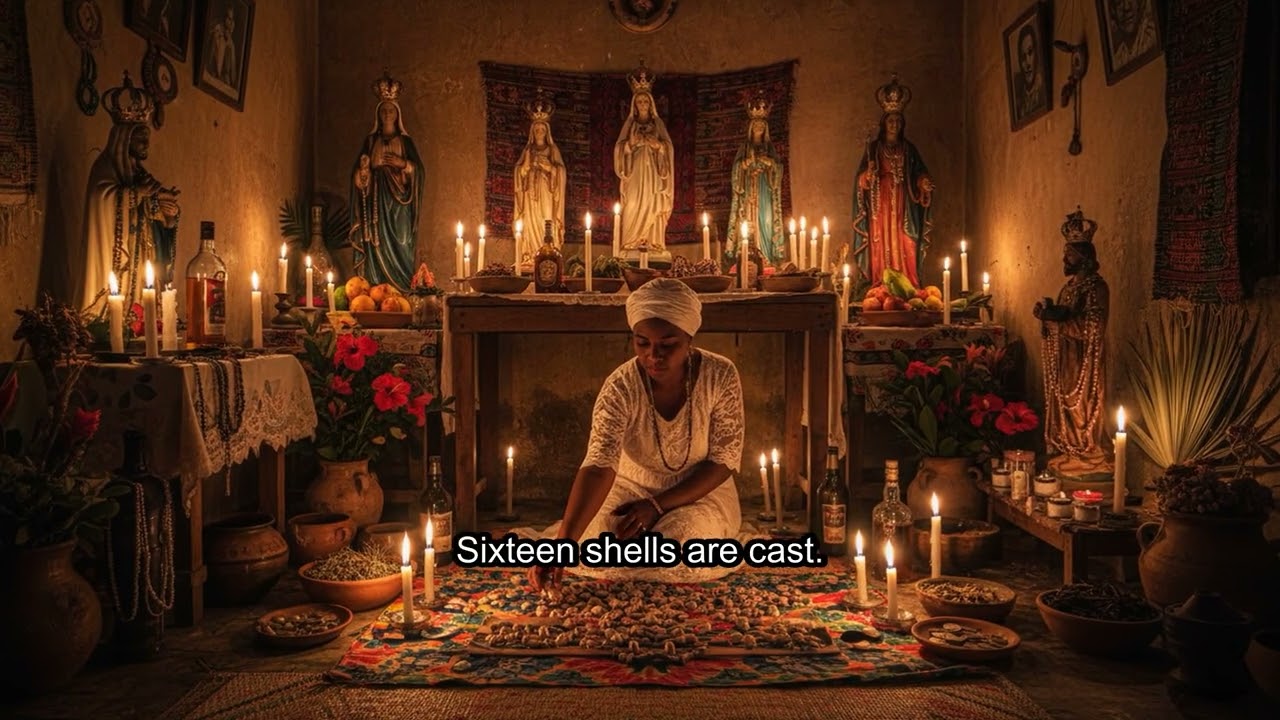
They found a third path. Recognizing that Catholic saints carried their own iconography, stories, and domains, enslaved Yoruba practitioners began mapping orisha onto saints with resonant attributes: Shango, lord of thunder, behind Santa Bárbara; Oshun, goddess of sweet waters, behind Our Lady of Charity; Ogun, master of iron, behind Saint Peter. On the surface, ceremonies looked like Catholic devotion. Beneath it, the orisha were being fed, drummed for, and honored exactly as before.
The Story Behind It
This blending is known as syncretism, and it was not a dilution of faith — it was a strategy of survival built on genuine theological insight. Enslaved communities in Cuba developed this fusion into Santería (Regla de Ocha), holding rituals inside what appeared to be ordinary Catholic feast-day observances. Drumming patterns — each orisha has its own sacred rhythm — carried liturgy that could never be written down or confiscated.
In Brazil, the tradition became Candomblé, practiced in temple communities called terreiros, where orisha were often called openly by their Yoruba names and devotees could be ritually possessed by the deity they served. In Haiti, orisha traditions merged with a related spirit system, the lwa, forming Vodou. This was never separate from politics: historians widely agree that Vodou ceremonies played a role in planning the Haitian Revolution, the only successful large-scale slave uprising in history — meaning orisha and lwa devotion didn't just endure oppression, it helped end it.
Because literacy and open worship were forbidden, knowledge moved through oral tradition — elders teaching initiates in seclusion, songs encoding prayers, drum rhythms functioning as scripture. Initiation into orisha priesthood remains today a demanding, multi-stage process of ritual transformation, through which practitioners receive their orisha's tools, colors, and secrets, earned rather than simply taught.
Diaspora Connections
The Yoruba diaspora built its own transatlantic network of knowledge long before anyone called it that. Santería priests in Cuba, Candomblé elders in Brazil, and Vodou practitioners in Haiti and Trinidad maintained contact and exchanged practice across colonial borders, sustaining a shared spiritual world even as they were separated by empire and ocean.
Today, an estimated 50 million people across the Americas, the Caribbean, and West Africa practice orisha-based traditions. In Cuba, a large majority of the population engages with Santería in some form; in Brazil, Candomblé holds official recognition as a religion. Remarkably, the exchange now runs in both directions — diaspora communities in Cuba, Brazil, and the United States are, in some cases, teaching Yoruba ritual knowledge back to communities in Nigeria, where centuries of Christian and Islamic influence altered some local practice. The gods that crossed the ocean in chains now connect their descendants in an unbroken, living circuit.