Cultural Context
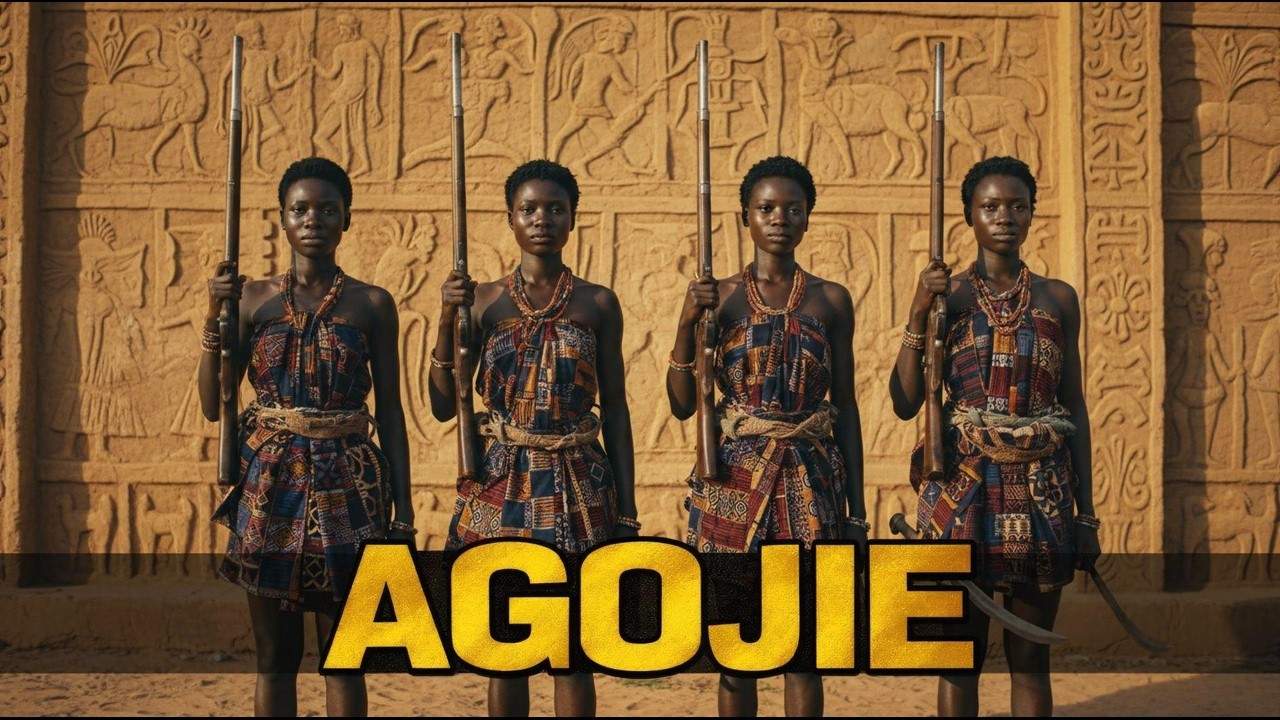
In the Kingdom of Dahomey, in what is now southern Benin, the Agojie were called Mino in the Fon language — "our mothers." That name matters. It tells you how Dahomean society understood these women: not as an oddity or an exception to womanhood, but as a maternal, protective force woven into the state itself. The palace walls at Abomey still carry bas-relief carvings of Fon power, and among those images are women bearing arms.
The Mino lived under celibacy while in service, trained separately from men, and held their own uniforms, weapons, and command structure. Some accounts trace their roots to royal elephant-hunting traditions and palace guard duty; by the early 1700s they were already a recognized presence at court. This was not a wartime improvisation. It was an institution, sustained across generations, paid from the royal treasury like any other arm of the state.
Historical Background
Founding dates for the unit are genuinely contested — some oral and documentary threads point to the 17th century, others to the early 18th. What is not contested is that by the 19th century, under King Gezo (roughly 1818–1858), the Agojie had grown into a full regiment of the royal army, with estimates ranging from 3,000 to 6,000 soldiers at their peak. Treat the exact number as a range; treat the professionalism as settled fact.
The regiment included riflewomen, archers, and blade fighters, each trained for endurance, obedience, and shock combat. They marched on campaign alongside Dahomey's male soldiers and fought the kingdom's wars against neighboring peoples — wars that were themselves bound up in slave raiding for the Atlantic trade. This is not a footnote to set aside from their bravery; it is the economic and political weather they served within. Dahomey was a militarized state that expanded through conquest and profited from the trade in captives. The Agojie were formidable soldiers inside a complicated kingdom. Both things are true at once, and neither cancels the other.
The Story Behind It
The Agojie's history reaches a hard turning point in the Franco-Dahomean Wars of 1890 and 1892, when Dahomey's forces met French colonial troops armed with repeating rifles. At the Battle of Kana in 1892, an Agojie assault broke against that firepower. King Béhanzin burned his own palace rather than let it fall intact to General Dodds. The regiment was broken as a formal institution — but the women themselves did not disappear into legend.
Some lived on into the 20th century. Photographs exist. Oral tradition holds that Nawi, photographed late in life, died around 1979, close to a hundred years old — a human ending, not a mythic one. European visitors like Norris, Forbes, and Burton wrote about the Mino as travel curiosities; French officers logged them in after-action reports as a tactical problem to be solved. Neither archive gets to own the whole story. In Benin, they are remembered as ancestors of a military tradition that Europe's own gender assumptions insisted shouldn't have existed. The label "Amazon," borrowed from Greek myth, was a way of making real Fon soldiers sound like exotic entertainment rather than documented history — and it's a label worth setting aside in favor of the name they were actually called.