Cultural Context
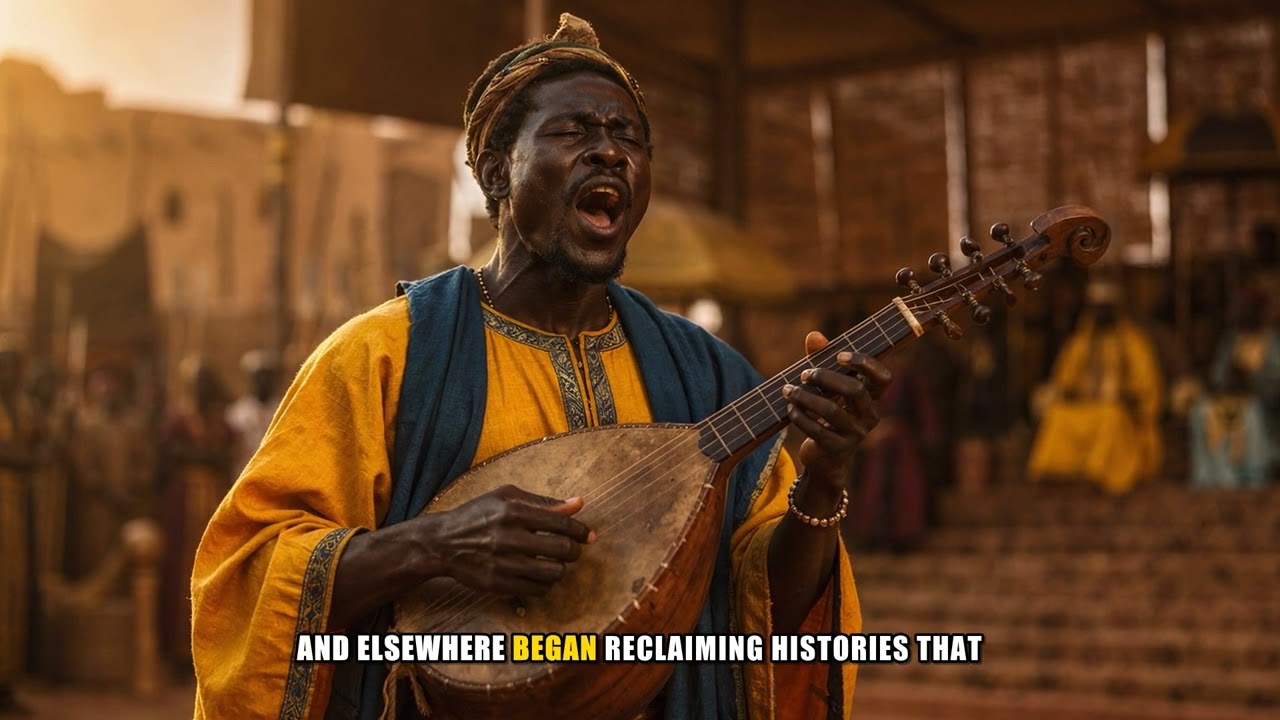
Among the Mande peoples of West Africa, history has never lived only on paper. The griot — a hereditary oral historian, musician, and advisor — carries the memory of dynasties the way a library carries books. For the Keita dynasty of the Mali Empire, griots recited genealogies, praise songs, and epics that stretched back to Sundiata Keita, the empire's founding figure, and forward through his descendants, including Mansa Musa.
This is not folklore in the sense of quaint old stories. Oral tradition among the Mande is a rigorous discipline, passed from teacher to apprentice over years, with exact wording and performance context mattering as much as content. A griot's recitation of the Keita lineage was, and remains, a form of historical record — living, verifiable within its own tradition, and renewed with every performance. That griots in Mali still perform these lineages today, seven centuries after Mansa Musa's reign, is a testament to oral tradition's durability when the conditions for its transmission are respected.
Historical Background
Mansa Musa ruled the Mali Empire in the early 14th century, presiding over a territory that stretched roughly 2,000 miles across West Africa and controlled much of the trans-Saharan gold trade. His 1324–25 hajj to Mecca, during which he reportedly distributed so much gold that he affected currency values in Cairo, made him famous across the medieval Islamic world and, soon after, in Europe.
By 1375, the Catalan Atlas — drawn by Majorcan cartographer Abraham Cresques — placed a crowned, gold-holding figure labeled "Musa Mali" at the center of the African continent, with a caption naming him the richest and most noble king in the land. Arabic-language sources from scholars across North Africa also documented Mali's wealth, its scholarship, and the city of Timbuktu's reputation as a center of learning.
This was not a hidden history. It was recorded, mapped, and known. But as Portuguese sailors opened Atlantic sea routes in the 15th and 16th centuries, the trans-Saharan gold trade that had sustained Mali's prominence declined, and European engagement with West Africa shifted toward the transatlantic slave trade. A new framework took hold — one that needed Africa to be a source of labor rather than a continent of kingdoms and scholars. By the 19th century, this framework hardened into outright denial: Hegel's claim that Africa had no historical part to play was written while the Catalan Atlas sat in a Paris library and Arabic manuscripts describing Mali's civilization existed across North African collections. The erasure was not ignorance. It was construction.
The Story Behind It
Three separate systems held the memory of Mansa Musa, and each faced its own obstacle to reaching global historical consciousness. The griots kept singing the Keita lineage, but oral tradition does not cross oceans in manuscript form — it depends on presence, language, and continuity of practice. The Arabic sources existed in libraries, but untranslated and inaccessible to the European and American scholarship building the modern discipline of world history. And the Timbuktu manuscripts — tens of thousands of texts on astronomy, law, medicine, and history — sat in basement rooms, metal trunks, and beneath desert sand, protected for generations by Malian families, waiting for a generation of scholars trained to look for them.
The shift began slowly. Nehemia Levtzion's Ancient Ghana and Mali (1973) offered one of the first serious English-language treatments of the empire. In 1981, a major compilation of early Arabic sources for West African history finally made primary documents accessible to wider scholarship. African scholars working in Dakar, Bamako, Accra, and beyond began reclaiming histories that colonial frameworks had filtered or dismissed. The Ahmed Baba Institute in Timbuktu took up the work of cataloguing and studying the surviving manuscripts.
Then came a moment of sudden, wide visibility: in 2012, Forbes ranked Mansa Musa as history's wealthiest individual, and the story spread through social media, articles, and even a video game. What struck people was not only the scale of his wealth — it was the plain fact that so many had never heard his name at all.