Cultural Context
Among the Mandé peoples, gold was never just wealth to be counted. It was understood as a substance carrying the force of the sun — sacred, alive, and bound up with kingship itself. The goldsmiths who worked it, known as jago, belonged to a distinct caste whose craft was treated as semi-magical, a skill that touched something beyond ordinary labor.
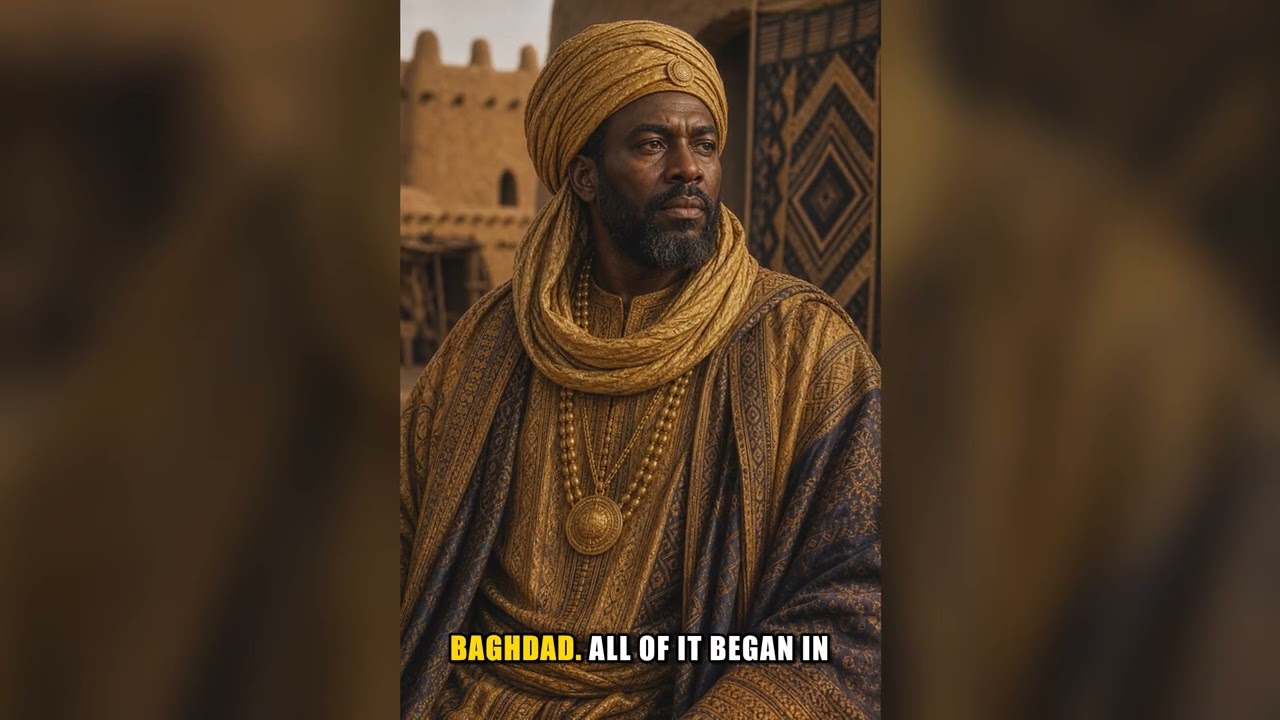
When a Mansa wore gold, he was not decorating himself. He was arming himself spiritually, wearing what amounted to armor for the divine authority that kingship in the Mali Empire required. This is why the throne claimed every gold nugget found within its borders by law — merchants could trade the dust freely, but the large nuggets, the ones that seemed to announce themselves as something more than currency, belonged to the Mansa alone.
This same court held space for both Islamic scholarship and Mandé divination without treating them as contradictions. Friday prayers and Ramadan observance sat alongside diviners consulted on questions of succession, harvest, and war. Ibn Battuta, visiting in 1352, was scandalized to see traditional ceremony performed beside Quranic recitation, and women moving unveiled through court life. For Mansa Musa, this was not two worlds in tension — it was one complete world.
Historical Background
In the 14th century, the Mali Empire sat atop the two commodities that ruled the medieval economy: gold and salt. The gold came from the fields of Bambuk and Bure, worked by free Mandé farmers who washed gold dust from riverbed gravel after the rainy season. The exact location of these mines was one of the best-kept secrets in the medieval world — protected not by walls, but by a trading system that kept outsiders permanently in the dark.
Arab geographers described this system with something close to bewilderment: a silent barter in which foreign traders left their goods on a riverbank and withdrew. When they returned, gold dust had appeared in exchange — no negotiation, no faces, no names, no map to the source. The Mansa knew where the gold was. He made certain no one else did.
Salt moved in the opposite direction, from a settlement called Taghaza, a thousand kilometers north in the depths of the Sahara. There, nothing grew — no trees, no water, no soil to build with, so the town itself was built from salt: walls of salt block, roofs held up by salt beams. The people who mined it were enslaved workers who depended entirely on caravans for food, since nothing at Taghaza could sustain life on its own. Salt was so valuable in sub-Saharan markets that it sometimes traded weight for weight against gold.
Mali controlled both ends of this exchange, and the caravans that crossed the Sahara between them — a 70-day journey, thousands of travelers strong, camels loaded with salt heading south and gold heading north. Ibn Battuta, crossing in 1352, recorded the remains of men and animals still lying along the route where they had fallen; the desert did not hide its dead. At the crossing's southern end stood Timbuktu, where the Sahara met the Niger River and two economic worlds exchanged their goods. By some estimates, Mali produced roughly half of the Old World's gold supply during this century — gold that ended up minted into Florentine florins and circulating through Cairo and Baghdad, spent by bankers who had never heard the empire's name.
The Story Behind It
The clearest proof of Mali's hidden power came in 1324, when Mansa Musa left Niani for his pilgrimage to Mecca. He traveled with a caravan reportedly numbering in the thousands, and with enough gold that when he passed through Cairo, his spending is said to have depressed the value of gold in Egyptian markets for years afterward — the first time the outside world glimpsed the true scale of what Mali controlled.
Before the Hajj, European and Middle Eastern mapmakers barely knew Mali existed. Afterward, the empire appeared on world maps — most famously the 1375 Catalan Atlas, which depicts Mansa Musa enthroned, holding a gold nugget, gazing out over the Sahara. The pilgrimage did not create Mali's wealth. It simply made visible a system that had run in silence for generations: gold moving north from Guinea, sold in Timbuktu, shipped from Egypt, minted in Florence, spent in Venice by merchants who never traced the coin back to its source.
That is the real shape of the story — not a king showing off his riches, but an empire that had quietly sat at the center of the medieval world's economy long before the world noticed it was there.