Cultural Context
Among the Akan of Ghana's Eastern Region, physical difference has long been a subject communities wrestle with openly, often through gossip, proverb, and eventually acceptance. The village in this story initially reduces Kofi's blindness and Amma's scars to a transaction — pity meeting desperation — because that is the easiest story to tell. It is a familiar pattern: visible difference invites speculation before it invites understanding.
But Akan oral tradition also carries a counter-current, one that insists character (suban) and how a person treats others in community matter more than outward form. Elders' proverbs frequently warn against judging by appearance alone, and this fable draws directly from that well. Kofi's certainty — "I know her heart. I know her soul. That's enough for me" — is not framed as naïveté born of blindness, but as a clearer kind of sight than the village possesses.
Amma's story also reflects something specific to how burn scars, common from cooking-fire accidents, have historically marked women in ways that shaped their sense of belonging and marriageability in many Ghanaian communities. Her years of avoiding mirrors speak to an internalized shame that the community's whispers only deepen, at least at first.
Historical Background
Community radio has a real and important history in Ghana, particularly from the 1990s onward, when FM stations began reaching towns and surrounding villages that national broadcasters often overlooked. These stations became vital civic spaces — broadcasting news, local music, church announcements, school updates, and storytelling programs in Akan languages like Twi.
What made community radio distinct was its intimacy: it connected people by voice alone, often live, with presenters known personally to their listeners. In many Ghanaian towns, the local station became something like a digital-age extension of the communal gathering space — a place where a teacher's announcement, a farmer's market update, or a young volunteer reading stories on air could reach an entire district.
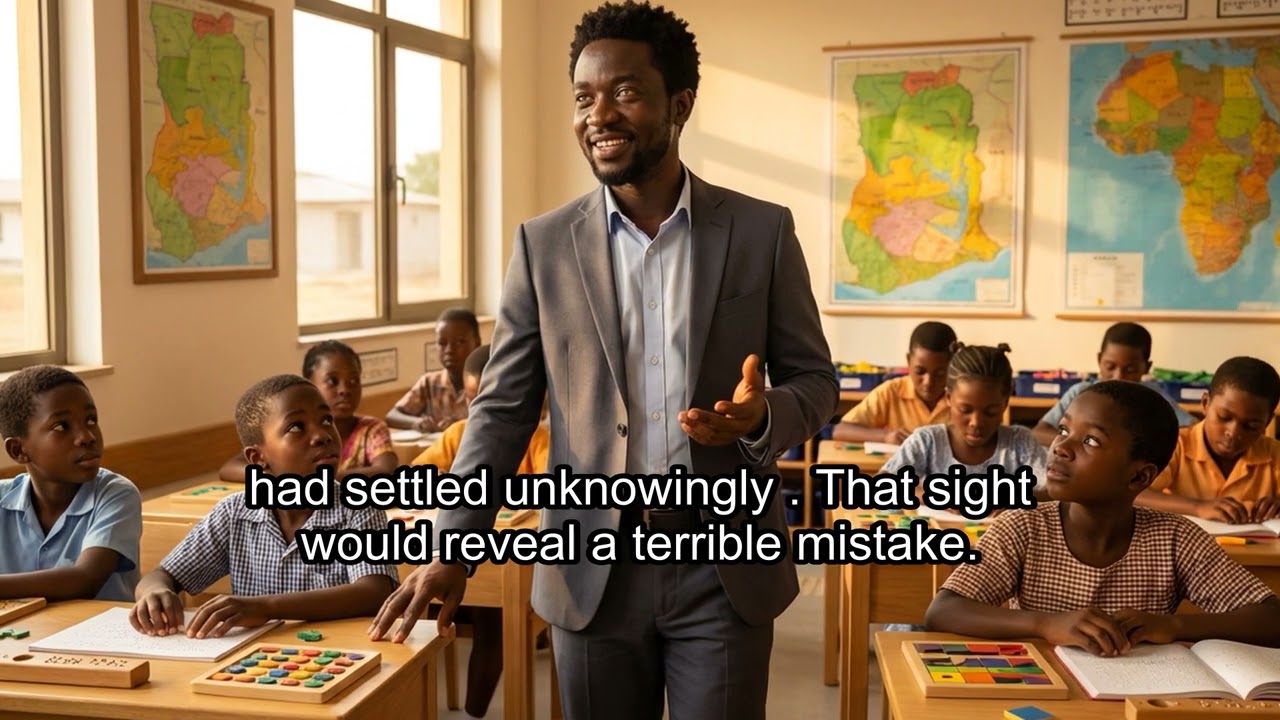
Schools for the visually impaired, like the one where Kofi teaches orientation and mobility, also reflect a genuine and growing tradition in Ghana of education built around adaptive skill — echo-location, touch-reading, spatial memory — rather than treating blindness as something to be merely accommodated. Kofi's teaching philosophy, that blindness is "difference, not deficit," mirrors real pedagogical shifts many Ghanaian institutions have championed.
The Story Behind It
The fable turns on a radio station as the site where Kofi and Amma actually meet each other — not the idea of each other filtered through appearance, but the real person carried entirely through voice. Amma is reading a story on air when Kofi walks in and stands listening, and what follows is not attraction built on glance but on sustained, unhurried conversation: books, teaching, music, "everything that mattered."
This structure matters. The village's cruelty ("she settled," "he doesn't know what he's getting") depends entirely on an assumption that sight is the truest sense — that what Kofi cannot see must be the most important truth about Amma. The story inverts this. Kofi's hands "read" Amma's like Braille; her scars become simply another texture in a person he already loves. Even Auntie Efua's opposition, rooted in maternal protectiveness rather than cruelty, voices the community's anxiety: how can love be trusted if it wasn't tested by sight?
The narrative complicates itself further by introducing the possibility of a surgery that could restore Kofi's vision — not as a fairy-tale reward, but as a genuine threat to what they've built. Amma's terror is not about losing Kofi's blindness; it's the fear that three years of being loved without being seen could be undone by seeing. That tension is the story's real engine, and it resists an easy resolution, treating both Kofi's curiosity about sight and Amma's fear as equally valid, human responses.