Cultural Context
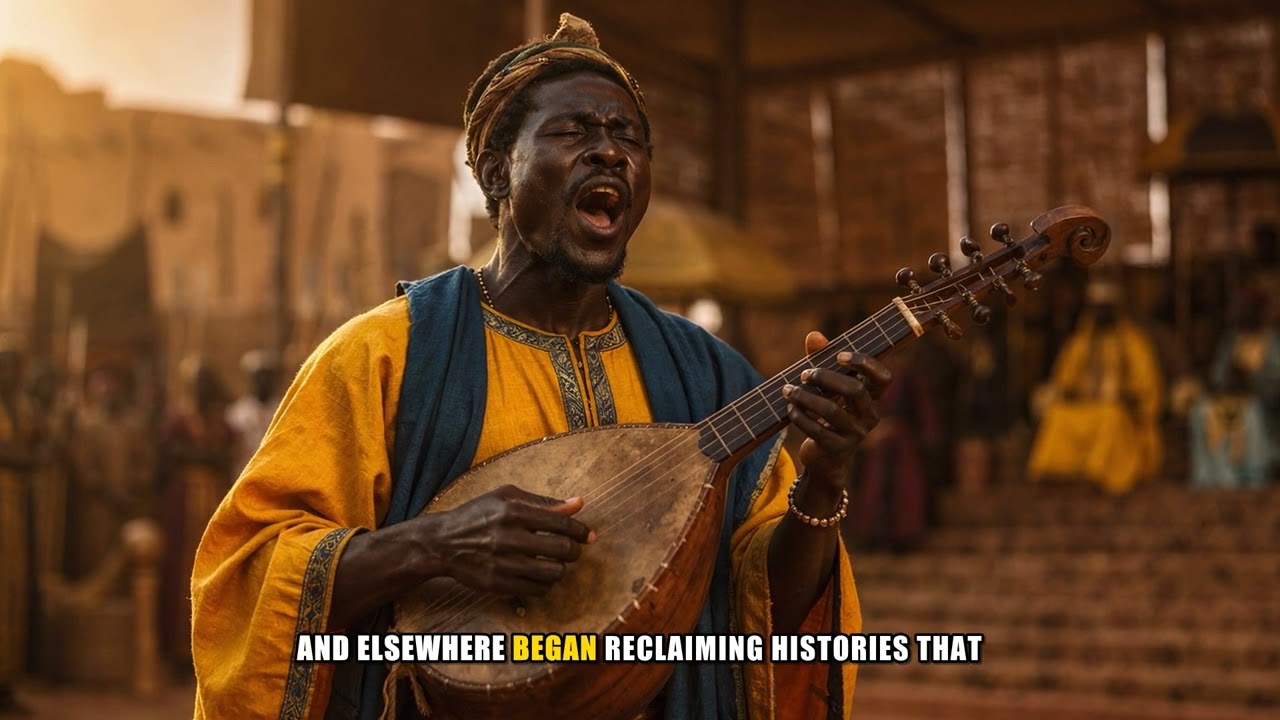
For the Mandé peoples of the Mali Empire, kingship was never a private matter — it was public performance woven from lineage, spirit, and now, faith. When Mansa Musa prepared to leave Niani in 1324, griots sang his lineage back through generations of kings to Sundiata Keita, the empire's founding hero. This wasn't ceremonial filler; among Mandé peoples, the griot is the living archive, the person whose voice makes history real and present rather than something locked away in the past.
What makes Musa's departure so striking is how comfortably Mandé tradition and Islamic obligation sat together that morning. Islamic scholars offered prayers alongside the griots' praise-songs. This was not a court choosing between two identities — it was a court that had folded Islam into Mandé statecraft over generations, since at least the conversion of Mansa Musa's ancestors. The hajj itself, one of the five pillars of Islam, was obligatory for any Muslim who was physically and financially able. Musa was unmistakably both, and the empire he ruled — built on the gold and salt trade of West Africa — gave him the means to make that obligation into something the world had never witnessed.
Historical Background
The distance from Niani, in the heartland of the Mali Empire, to Mecca was some 4,000 to 5,000 miles — north across the Sahara, on to Cairo, then southeast through the Sinai and down the Arabian Peninsula. Each leg took a month or more of travel before Musa's retinue reached the holy city.
The scale of that retinue is documented by the Arab historian Al-Umari, who gathered eyewitness accounts in Cairo not long after Musa passed through. He recorded a personal escort of 60,000 people, 500 heralds walking ahead carrying gold staffs of half a kilogram each, 80 to 100 camels carrying 300 pounds of gold dust apiece, and thousands of enslaved attendants each bearing four pounds of gold bars. Musa's principal wife, Inari Kunte, traveled with her own retinue of 500 women, and a bathhouse was reportedly built fresh at every stop along the route for her use — a detail that survived centuries of retelling precisely because it signaled how deliberate and visible her presence was.
Historians today treat some of these numbers as likely inflated in the retelling, but even a conservative reading — 10 to 18 tons of gold moving through the medieval world in one procession — describes something unprecedented. That gold wasn't simply carried for display. Musa distributed it as charity along the route, as the hajj requires, gave diplomatic gifts to the Sultan of Egypt and the lords of the Hejaz, and set money aside to endow mosques and scholars. The consequence, intended or not, was economic disruption. When Musa passed through Cairo, he and his retinue spent and gave away so much gold that the metal's value in Egyptian markets reportedly collapsed for over a decade afterward — a rare instance of one traveler's spending reshaping a regional economy on the far side of a continent.
The Story Behind It
Before the procession could begin, Musa had to cross into a spiritual state that erased every marker of the power he carried. This is ihram — the plain white garment every pilgrim wears once they enter the sacred state of the hajj. In ihram, there is no king, no gold, no title. Every pilgrim, however wealthy, stands before God dressed the same as everyone else.
For a ruler who had spent his reign wearing gold as a kind of spiritual and political armor — who commanded tens of thousands of people and controlled trade routes that fed the medieval world — putting on that plain cloth was not a small thing. The story doesn't tell us what Musa felt in that moment, only that he did it, because the hajj asks the same of every Muslim regardless of throne or treasury.
Then came departure: the dust of a hundred thousand people and their gold rising behind them as they moved north into the desert, while the people of Niani watched their king leave for a pilgrimage that would take the better part of a year, one household, one funeral procession's worth of gold and provisions at a time. The dust settled behind them. Ahead lay Cairo, the Sinai, the Hejaz, and Mecca.