Cultural Context
Among the Akan peoples of present-day Ghana, a person is understood to be made of several interwoven parts: the okra (soul, a fragment of the Supreme Being), the mogya (blood, inherited from the mother's line), and the sunsum — the spirit-self, or personal force of character and vitality. Sunsum is not fixed; it can be strong or weak, bright or dimmed, depending on how a person lives and who they spend their energy on. A person with a forceful, luminous sunsum is said to command respect and presence. A person whose sunsum has been worn down by envy, conflict, or draining relationships may fall ill, lose their spark, or become 'a shadow of themselves.'
This is not superstition set apart from daily life — it is a practical vocabulary for describing exactly the kind of emotional depletion many people now call being 'drained' by a relationship. When elders counsel a young person to be careful whose company they keep, they are often speaking, in effect, about sunsum: protecting one's spirit-force from those who would siphon it for themselves.
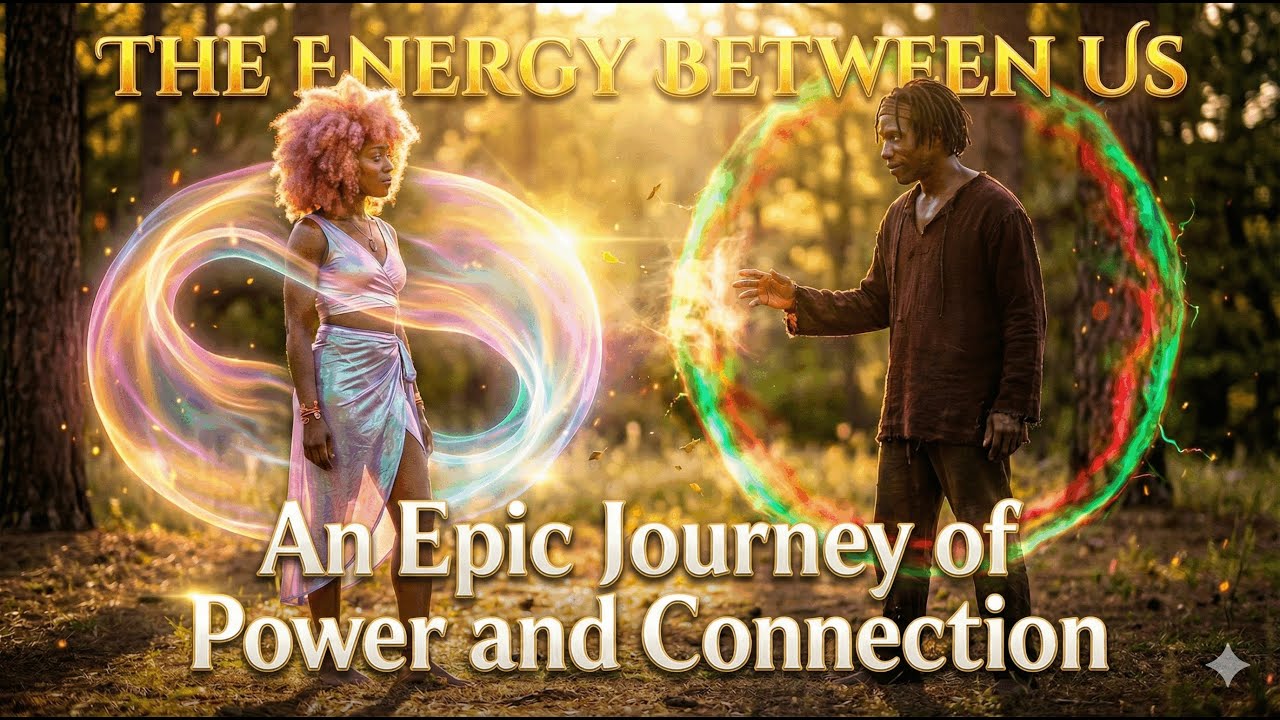
The Energy Between Us borrows this same grammar for a contemporary, cinematic audience. Luma, radiant and unguarded, and Drain, hollow and hungry for light, dramatize a dynamic the Akan tradition named long before the language of 'energy vampires' entered popular psychology.
Historical Background
Akan oral tradition has always used personified figures — animals, spirits, ancestors — to make abstract truths about character legible to ordinary people. Anansi the spider is the best known of these figures internationally, but alongside trickster tales, Akan communities have long told stories that personify moral and spiritual states themselves: greed as a hungry spirit, jealousy as a shadow that follows a person home, generosity as a light that grows the more it is given away.
These personifications served a specific teaching function. Rather than lecturing a child or a quarreling couple about boundaries, an elder could tell a story about a bright figure and a hollow one, and let listeners recognize themselves. The story does the diagnostic work that direct confrontation often cannot.
What's notable about The Energy Between Us is not that it invents this technique, but that it inherits it. A film using stylized, minimal dialogue, an unnamed 'meadow where the earth first dreamed her,' and archetypal names like Luma and Drain is working in the same register as oral tradition's long habit of turning felt experience — the chill you feel around a certain person, the dimming of your own laughter — into a figure you can name and therefore resist.
The Story Behind It
The film's plot is deceptively simple: Luma, full of unearned light, meets Drain, who takes from her in small, deniable increments — 'a comment here, a question that curled like a hook.' She dims. She notices the stream feels colder, her own laughter duller. Then, crucially, she does not confront Drain or seek revenge. She climbs back to the sun, to the place where 'her light stretched out, not to prove, but to be.'
Read through the lens of sunsum, this is a story about restoration rather than victory. In Akan thought, the remedy for a depleted spirit-self is rarely combat with whoever depleted it; it is a return to the sources that replenish it — kin, ancestors, the sun, water, right relationship. Luma's climb 'not to escape, but to return to herself' mirrors this: she does not need Drain to change or apologize. She needs to relocate her own source.
The narrator's closing insight — 'it was never about him... it was about the energy between us, what we give, what we guard, what we allow to grow' — states outright what oral tradition usually leaves implicit: that vital force is relational. It moves between people. This is precisely the Akan understanding of sunsum as something that can be strengthened in community or eroded by it, never simply private.
Diaspora Connections
Concepts of vital, transferable spirit-force are not unique to the Akan; related ideas appear across West and Central African traditions carried into the diaspora — from the Kongo notion of mooyo to Yoruba understandings of ase, the force that animates and empowers action. In the Americas, these ideas persisted and transformed within traditions such as Hoodoo, Vodou, and various African diasporic spiritual practices, where 'energy,' 'aura,' and protecting one's spirit from those who would drain it remain common ways of talking about relationships and boundaries.
When contemporary media — memes, self-help language, films like this one — speak of 'protecting your energy' or 'energy vampires,' they are, whether consciously or not, echoing a much older and more specific set of ideas about sunsum and its relatives. The Energy Between Us sits at that meeting point: a cinematic parable that feels thoroughly modern while working from ancestral logic.