Cultural Context
Angola's independence story cannot be told through one people's memory alone. The MPLA drew its strength from Luanda's urban, multiracial intellectual class and coastal communities. The FNLA rose from the Bakongo peoples of the north, with deep ties across the border into Zaire. UNITA found its base among the Ovimbundu, Angola's largest ethnic group, concentrated in the central highlands. These were not interchangeable factions — each carried its own language traditions, regional loyalties, and oral histories of resistance to Portuguese rule.
This matters because the tragedy of 1975 is often flattened into a simple story of foreign meddling. It was that, but it was also something older: distinct Angolan peoples with distinct visions of nationhood, each unwilling to be erased by the others' definition of freedom. Understanding Angola's civil war means naming the Bakongo, the Ovimbundu, and Luanda's mixed urban communities as real political actors, not background noise to a Cold War drama.
Historical Background
Portuguese ships first arrived on the Angolan coast in 1483, and they never left. Over four and a half centuries, Portugal extracted diamonds, oil, and — for much of that history — enslaved people, building one of the longest-running colonial economies in Africa. Unlike Britain and France, Portugal refused to decolonize as the rest of the continent gained independence through the 1950s and 60s. Salazar's dictatorship insisted Angola was not a colony at all, but Portugal itself.
The cost of that fiction was measured in Angolan lives: forced labor camps, diamond mines that enriched Lisbon while leaving local communities with 98% illiteracy and a life expectancy under 40. By February 1961, that pressure broke into open revolt — first at São Paulo prison in Luanda, then across the cotton and coffee plantations of the north, where forced laborers rose up with machetes. Portugal answered with napalm and aerial bombing, killing an estimated 20,000 to 50,000 Angolans. Out of that repression, three separate liberation movements hardened into permanent rivals: the MPLA, the FNLA, and UNITA.
The Story Behind It
Through the 1960s and early 70s, all three movements fought Portugal — and increasingly, each other. The Soviet Union and Cuba backed Agostinho Neto's Marxist MPLA. The United States, working through Mobutu Sese Seko's Zaire, funneled money to Holden Roberto's FNLA. Jonas Savimbi's UNITA, born from a split with the FNLA, built its own path among the Ovimbundu, shifting ideology as needed to hold power.
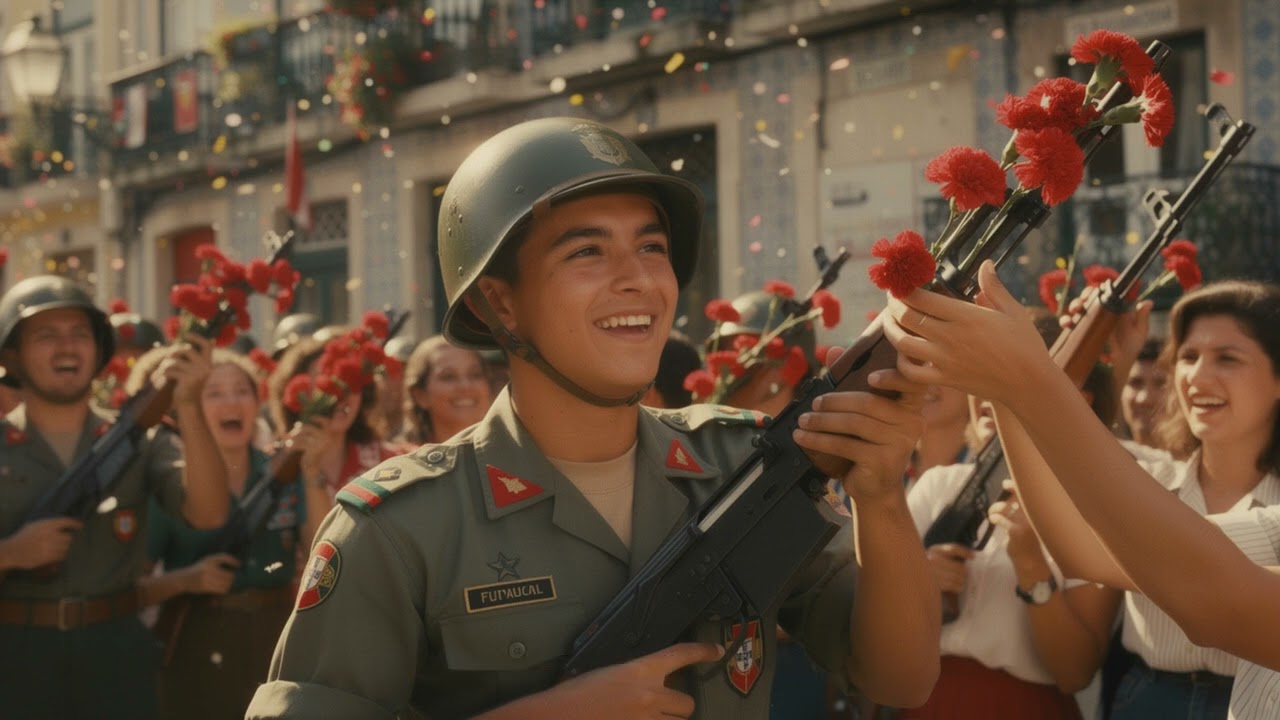
The breaking point came not in Angola, but in Lisbon. On April 25, 1974, Portuguese military officers overthrew the dictatorship in the Carnation Revolution, named for the flowers soldiers placed in their rifle barrels. Portugal's African empire, having drained 40% of the national budget and cost 11,000 soldiers' lives across three colonial wars, was finished. Independence for Angola, Mozambique, and Guinea-Bissau was suddenly real.
In January 1975, Neto, Roberto, and Savimbi signed the Alvor Agreement, promising a shared transitional government ahead of elections. The handshake photographs told one story; the agreement lasted nine months before collapsing into open street battles in Luanda. As 300,000 Portuguese settlers fled in a panicked airlift — many sabotaging machinery and equipment on their way out — Angola was left with no functioning government, an independence date fixed for November 11, and three armies racing to seize the capital before the clock struck midnight. When that moment came, all three leaders declared themselves president on the same night, and the liberation struggle became a 27-year civil war fed by Soviet, Cuban, American, and South African intervention.