Cultural Context
Among the Shona peoples of what is now Zimbabwe and neighboring regions, the past is not something sealed away in dusty archives — it is carried forward through ngano (oral narratives), praise poetry, and the testimony of elders who serve as living libraries. Great Zimbabwe, the vast stone city whose ruins still stand near modern Masvingo, occupies a central place in this tradition. It was not built by outsiders, as colonial-era writers once insisted against all evidence, but by Shona ancestors, most likely of the Gumanye and later Zimbabwe culture, between roughly the 11th and 15th centuries.
In Shona storytelling, ancestors (vadzimu) are not distant figures but active presences who guide the living, appearing in dreams, at family shrines, and in tales exactly like the one about Cuda and Tapiwa consulting an elder, Sekuru Yasha, and later meeting spirits in the Matobo Hills. This reflects a real and enduring belief: that wisdom flows between generations, and that sacred landscapes — hills, caves, stone enclosures — are places where that flow becomes tangible.
Historical Background
Great Zimbabwe was, at its height in the 13th and 14th centuries, one of the most sophisticated urban centers in the medieval world. Its famous dry-stone walls — built without mortar, using granite blocks fitted with extraordinary precision — enclosed a royal city that may have housed up to 18,000 people. The Great Enclosure alone, with walls over 11 meters high, remains one of the largest ancient structures in sub-Saharan Africa.
The city sat at the center of a trade network stretching to the Indian Ocean coast and beyond. Archaeologists have recovered Chinese porcelain, Persian glass beads, and Arabian coins from the site — physical proof that Shona traders exchanged gold, ivory, and cattle for goods from across the known world. This cosmopolitan reality echoes directly in the story's marketplace scene, where Cuda and Tapiwa find themselves surrounded by 'unfamiliar spices' and people in 'robes adorned with golden beads.'
Great Zimbabwe's decline by the 15th century, likely due to overpopulation, resource strain, and shifting trade routes, gave rise to successor states like the Mutapa and Rozvi kingdoms, which carried Shona stonemasonry traditions forward. The site was never truly abandoned in memory — it remained sacred ground, and its name literally gave Zimbabwe its own.
The Story Behind It
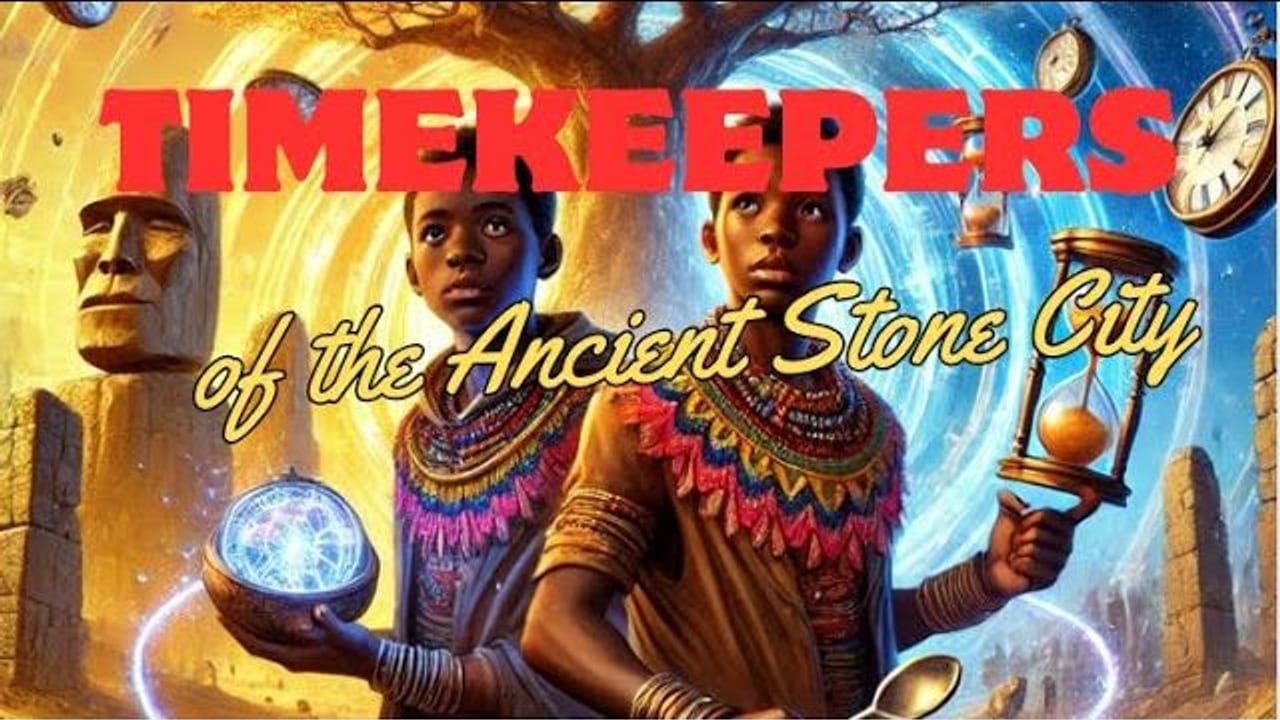
"Timekeepers of the Ancient Stone City" is a contemporary retelling that uses time travel as a device to dramatize something Shona oral tradition has always insisted on: that the past, present, and future are morally connected. Cuda and Tapiwa's journey backward to witness the city's construction and forward to see ecological ruin mirrors a recurring theme in Shona teaching tales — that greed and the abuse of power (embodied here by the ambitious King Zea) create consequences that ripple across generations.
The copper plate, silver spoon, and gold coin function like enchanted objects in classic oral narratives — tools that test the character of those who find them rather than simply granting power. The elder who interprets the artifacts' meaning, and the ancestral spirits in the Matobo Hills who charge the boys with 'mending the threads of time,' stand in for the real role elders and spiritual mediums (masvikiro) play in Shona communities: interpreting how ancestral will bears on present choices.
This is not a distortion of history but an imaginative extension of it — new fiction built on a genuinely old foundation, much as oral storytellers have always adapted inherited material to speak to present concerns, in this case environmental neglect and the temptation of unchecked ambition.