Cultural Context
Among the Tonga peoples who live along the Zambezi River in what is now Zimbabwe and Zambia, Nyami Nyami is not a distant myth but a present, living force. Described as a serpent-like river spirit with the head of a fish (or sometimes a dragon-like creature), Nyami Nyami is understood to inhabit the deep waters of the Zambezi Gorge and to control the river's moods — its floods, droughts, and the safety of those who fish and farm along its banks.
For the Tonga, the river is not simply a resource; it is a relationship. Offerings, prayers, and careful conduct near the water are ways of maintaining balance with Nyami Nyami, and stories like the one of Tasi and Rudo (also called Chipo) teach that greed, cruelty, and disrespect toward the river's order bring ruin, while humility and stewardship bring blessing. This is the grammar of Tonga cosmology: the natural world is alive with intention, and human fortune rises or falls according to how well people honor that intention.
Such tales are told and retold — by grandmothers by the fire, by fishermen recounting close calls on the water, by families explaining why certain stretches of river are treated with particular caution. This is oral tradition functioning exactly as it should: teaching ethics through narrative, generation after generation.
Historical Background
Nyami Nyami's story took on a new, painful chapter in the 1950s. Between 1955 and 1959, British colonial engineers dammed the Zambezi at Kariba Gorge to build one of the largest hydroelectric projects in the world. For the Tonga peoples living in the gorge, this was catastrophic: roughly 57,000 people were forcibly relocated from the fertile river valley to drier, less hospitable land, with little consultation and minimal compensation.
During construction, the Zambezi experienced unusually severe floods in 1957 and 1958 that destroyed work on the dam wall and killed workers. Many Tonga interpreted these floods as Nyami Nyami's fury — the river god resisting the separation of the dam from his mate, said to live downstream, and punishing the disruption of the river's natural order. Engineers called it an engineering failure; the Tonga called it a warning.
The dam was ultimately completed, creating Lake Kariba, one of the largest artificial lakes in the world, and permanently altering the Zambezi's flow. But the disruption did not erase Nyami Nyami — if anything, it cemented his significance as a symbol of resistance, loss, and the cost of ignoring Tonga knowledge of the river.
The Story Behind It
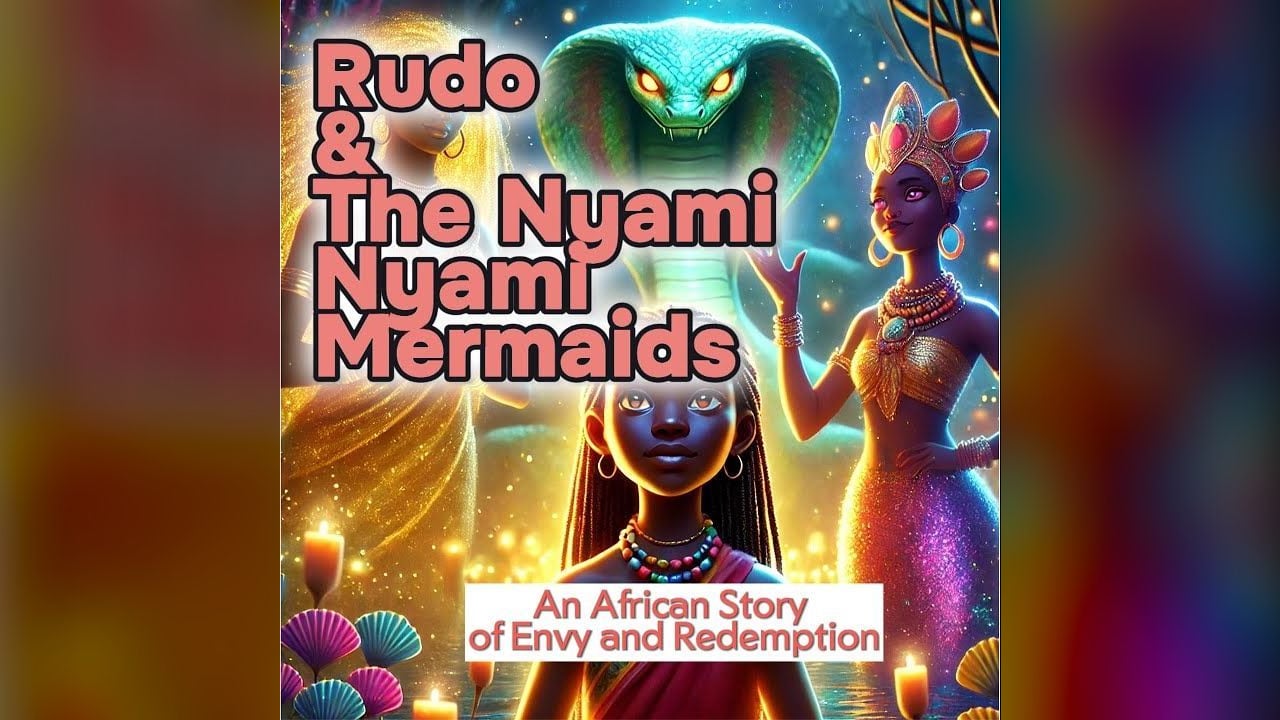
The tale recounted in this fable centers on Tasi, a woman consumed by envy of her neighbor's happy family. Seeking wealth through a forest sorcerer named Mapo, she is told the price is steep: the blood of an innocent child offered to the river. She lures her neighbor's daughter, Rudo, to the Zambezi and pushes her into the water, believing this sacrifice will win Nyami Nyami's favor.
But Nyami Nyami's power does not reward cruelty — it judges it. Rather than allowing Rudo's death, he sends his mermaid guardians to carry the girl to a hidden underwater village, where she spends five years learning directly from the river god: how water shapes land, how rain and wind move together, how to read the river's ripples to prevent flood or drought, and how to work with the crocodiles and fish who serve as the river's allies. Rudo, later called Chipo, emerges transformed — not just alive, but wise, carrying the river's own knowledge back to her people.
Meanwhile Tasi's stolen prosperity collapses into ruin, her husband vanishes, her son sickens, and she is left an outcast muttering over what she lost. Chipo, in contrast, becomes a source of healing for the whole village, and she urges everyone to honor Nyami Nyami — not through sacrifice extracted by force, but through living in harmony with the river and each other. The moral is unmistakable: the river gives to those who respect its balance and takes from those who try to exploit it through violence or shortcuts.